
This post was written by Giovanny Avillaneda, a Customer Success Specialist at Block 64.
What is SaaS tier inflation?
SaaS tier inflation is the gradual accumulation of premium-tier licenses as temporary upgrades become permanent entitlements.
Typically, a user gets a premium SKU for a defined need. Then the need expires, but the license level doesn’t.
Because SaaS billing is aggregated and renewals are automated, incremental upgrades rarely get reviewed in isolation. So, finance sees total subscription cost, IT sees active accounts, and no one systematically compares assigned SKU against real feature usage.
The result is cost escalation without any matching productivity increase, and it’s waste generated entirely by active users on tiers they don’t use.
Why tier inflation evades normal SaaS cleanup
Most SaaS optimization focuses on removing inactive users. That’s reasonable, since industry benchmarks consistently show 25 to 30% of software spend wasted on unused and underutilized licenses.
But deactivation reviews fail to identify tier inflation. A user logging in daily looks healthy, even if they never touch the premium analytics, AI add-ons, or advanced security features their SKU pays for.
The scale of what hides this way is significant. One Block 64 partner found 2,000 unused Office licenses at a single 7,000-user client: paid desktop licenses for users who weren’t using desktop Office at all.
Tier misalignment among active users follows the same pattern, but one level up. The account is active, but the entitlement is wrong.
Five governance gaps feed the inflation:
- Temporary premium access granted without expiration criteria
- AI and advanced features enabled broadly instead of selectively
- No structured downgrade workflow (upgrades have a process, downgrades have a hope)
- No ongoing comparison of SKU level against actual feature consumption
- Renewals negotiated from historical entitlements rather than current need
Manual audits can’t scale across dozens of platforms. Procurement lacks usage telemetry, IT lacks entitlement visibility, and Finance never sees feature-level activity.
What effective insight looks like
Beating tier inflation takes three connected views: usage telemetry, license entitlement, and cost exposure in one governance picture.
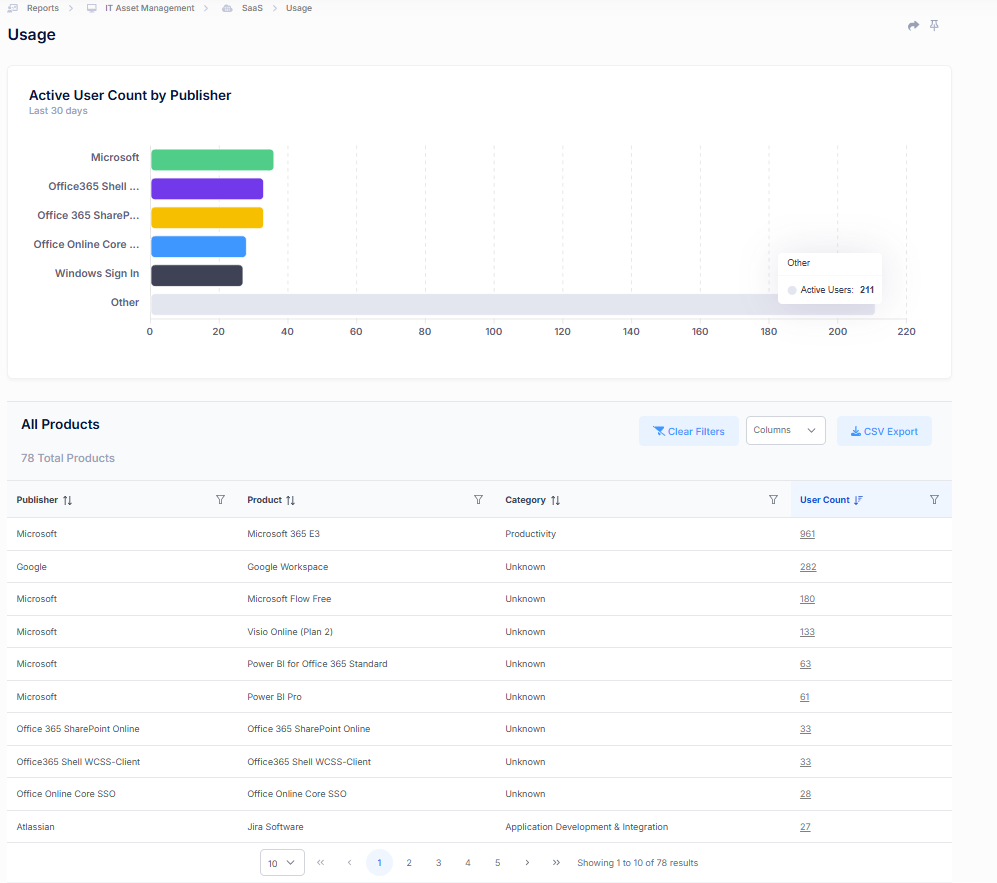
SaaS usage by publisher and product
Usage reporting shows active user counts by publisher and product over time: activity concentration, low-engagement products, and how usage distribution compares to assigned license volume.
High user counts with low advanced-feature engagement turn downgrade eligibility from an assumption into a measurement.
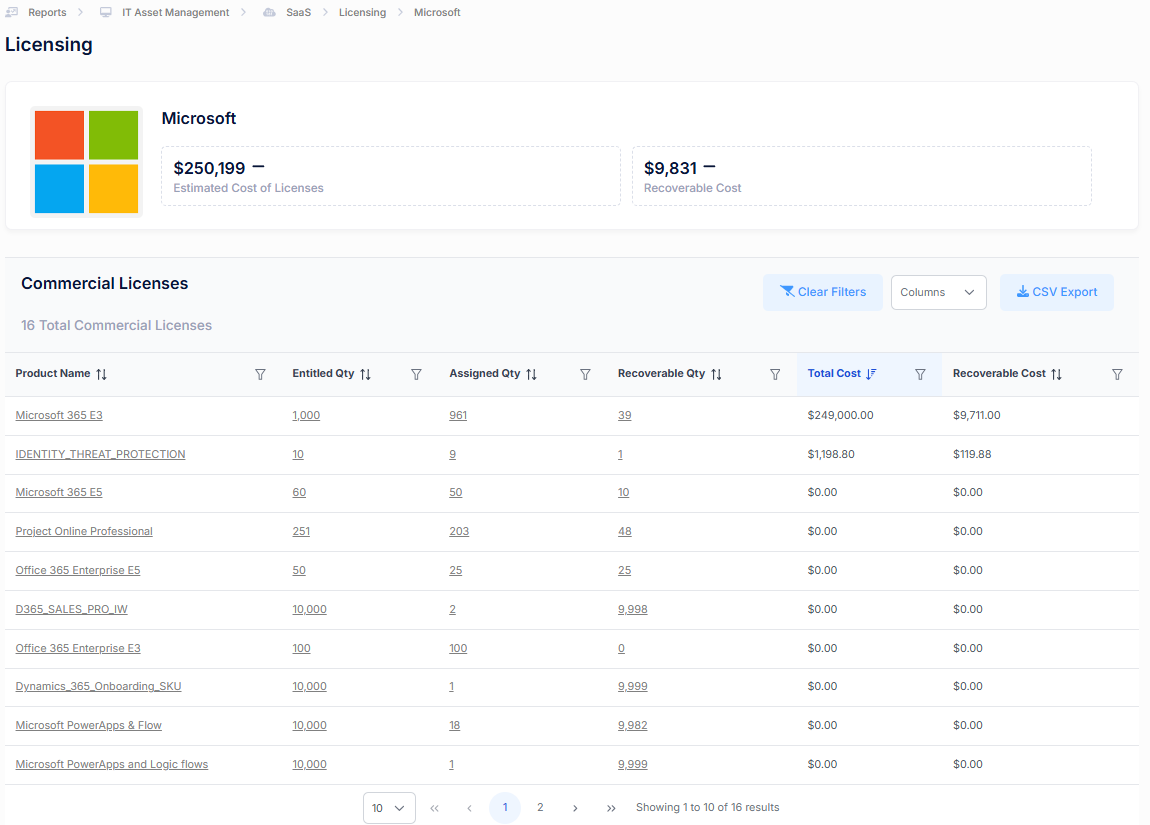
Entitlement vs. assignment
Licensing reporting puts entitled quantity, assigned quantity, recoverable quantity, and total cost side by side. It exposes where premium SKUs exceed need and which recoverable licenses represent downgrade or reassignment opportunities.
When assigned volume stays high but usage doesn’t justify the tier, intervention is evidence-based instead of political.
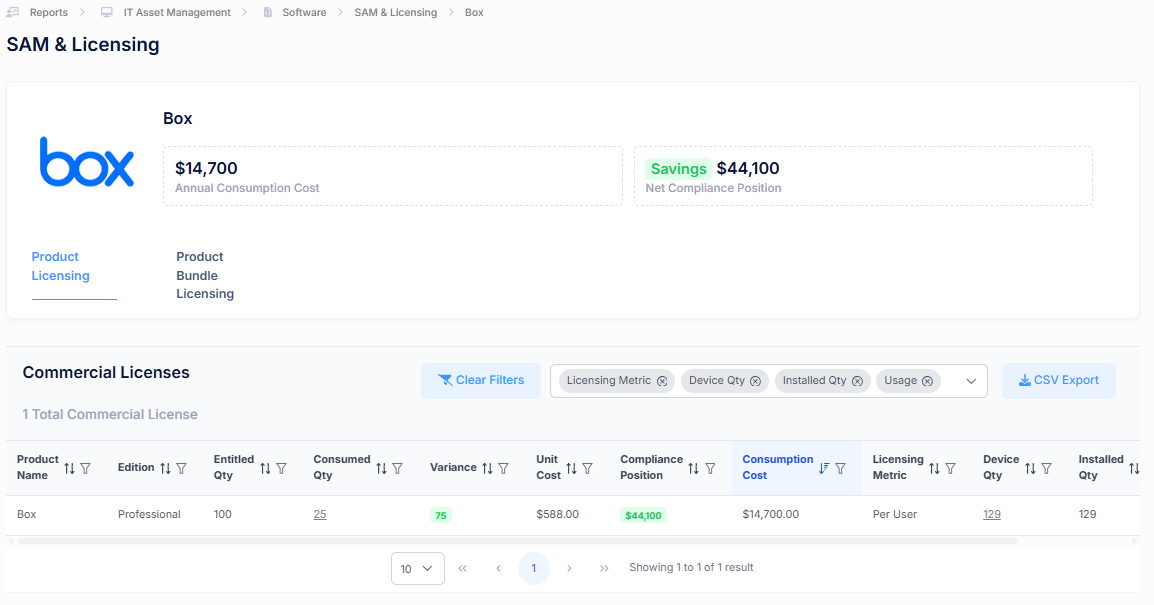
Consumption cost and compliance position
SAM reporting quantifies consumption cost, compliance variance, and savings potential, reframing license governance as continuous financial alignment rather than an annual reconciliation scramble.
Correlate all three views and the systematic findings fall out:
- Over-licensed active users
- Temporary upgrades never reviewed
- Departments defaulted to premium without adoption
- Renewal exposure built on inflated baselines
Treat license tiers as lifecycle-managed assets
The ITAM fix is structural. A license tier is a governed asset with lifecycle states, not a static entitlement.
Every upgrade should carry four things:
- A defined purpose
- An accountable owner
- A review interval
- Downgrade criteria
Do that, and a "temporary change" stays temporary. The objective isn’t restricting access. It’s keeping entitlements aligned with measurable usage, continuously.
Note: the broader reclaim methodology lives in our software license optimization guide.
Deflate before you renew
Tier inflation never announces itself. No budget shock, just a renewal quote that’s mysteriously grown again.
The pattern only becomes visible when usage, entitlement, and cost data are connected, and only becomes fixable when upgrades carry lifecycle governance.
Before your next renewal cycle, ask one question. How many of our premium tiers would survive a usage-based review?
If you can’t answer with data, that’s the gap — and it’s measurable within days.
Walk into renewals with the numbers Block 64 visualizes usage versus assigned SKUs across your SaaS estate and identifies recoverable and misaligned licenses, so renewal negotiations start from evidence rather than the vendor’s baseline. Start a free trial, learn about Rapid Assessments, or contact sales.