Last Updated: June 25, 2026
The best SaaS management tools in 2026, at a glance
The best SaaS management tools in 2026 are BetterCloud, Zylo, Zluri, Trelica, and CloudFuze. Each is strong for a specific SaaS need: automation and admin control, spend and renewal tracking, or user-level access governance. For teams running hybrid environments, Block 64 extends past SaaS to give unified visibility across SaaS, on-premise software, cloud workloads, and hardware in one platform.
Best SaaS Management Tools 2026: Top 6 Compared
Over the past two decades, the software landscape has transformed dramatically. In the early 2000s, most software ran locally on desktops or servers, requiring installations, licensing keys, and significant infrastructure. Early pioneers like Salesforce shifted this model by introducing browser-based software that required no local installs and could be purchased and deployed quickly.
As cloud infrastructure providers such as AWS and Azure matured, SaaS adoption accelerated. Companies rapidly accumulated “browser-based SaaS” tools across every department—from collaboration and HR to security and analytics. This ease of acquisition, combined with decentralized purchasing, created challenges around visibility, cost control, entitlement tracking, and security governance.
This environment led to the emergence of SaaS Management Platforms (SMPs). According to Gartner’s Magic Quadrant for SaaS Management Platforms, SMPs typically focus on:
- Discovering SaaS usage
- Centralizing subscription and renewal data
- Improving configuration and access visibility
However, SMPs generally focus only on SaaS. Modern IT environments blend SaaS with licensed/on-prem software, cloud workloads, and hardware endpoints. Relying on SaaS-only tools leaves gaps in visibility that impact spend optimization, security posture, and audit readiness.
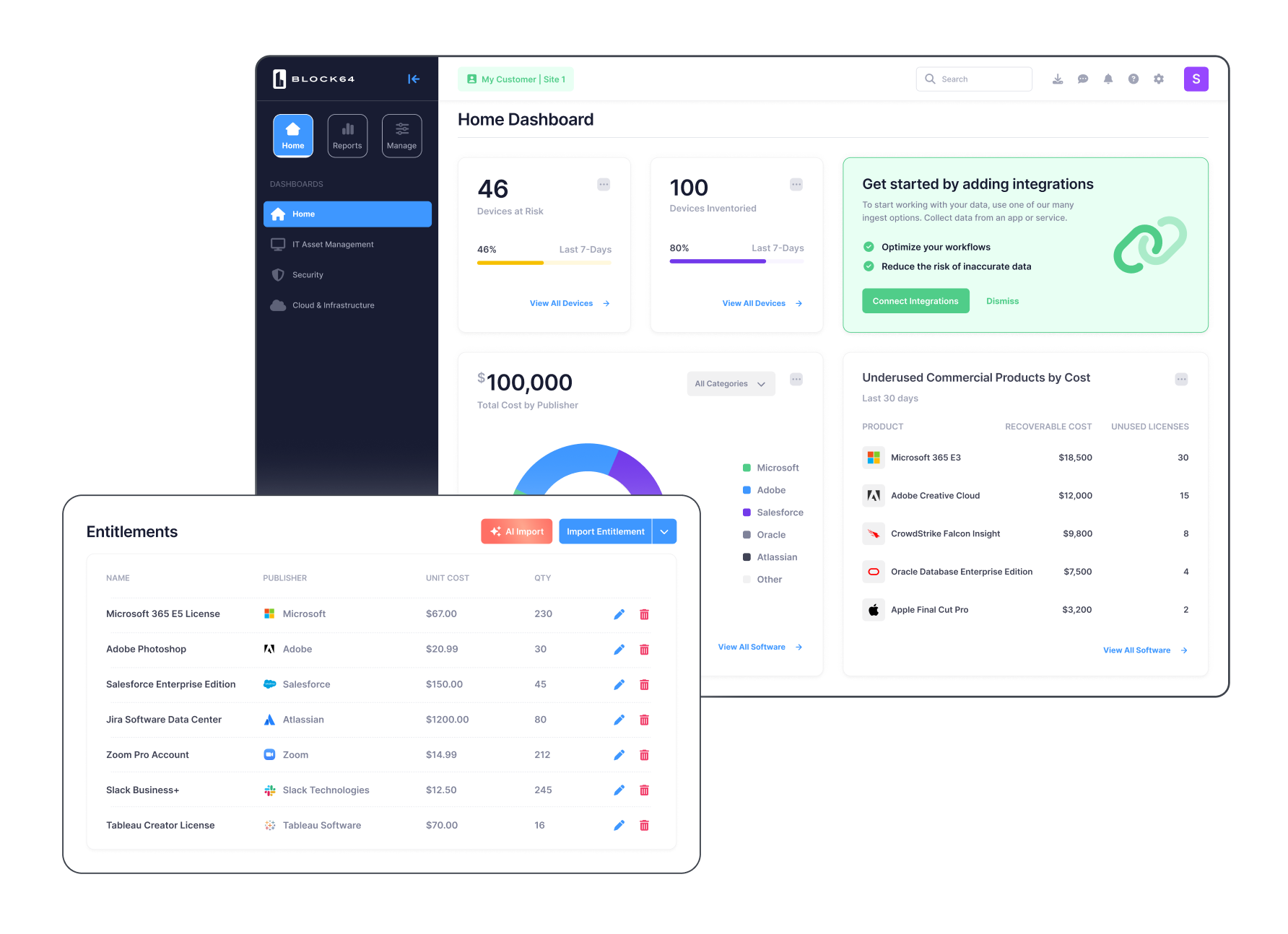
This is where Block 64 differs. Rather than functioning as a traditional SMP, Block 64 provides unified IT visibility across critical SaaS applications, on-prem software, cloud resources, and hardware endpoints—giving IT, finance, and leadership teams a consistent, connected view of their technology environment.
This guide compares leading SaaS management tools in 2026 and explains how organizations are evolving toward broader visibility solutions as hybrid IT becomes the norm.
What Is a SaaS Management Tool?
A SaaS Management Tool (or SaaS Management Platform, SMP) helps organizations identify and manage the SaaS applications used across the business. SMPs consolidate data from SSO, finance systems, and usage logs to surface which SaaS tools are in use, who has access, and how much each tool costs.
Gartner identifies three core SMP capabilities:
- SaaS Discovery – detecting applications used across the organization
- Spend Governance – tracking subscription costs, usage levels, and renewals
- Security Posture – improving configuration, permissions, and access visibility
While SMPs help regain control over SaaS, they do not typically cover:
- Licensed/on-prem software
- Cloud workloads
- Infrastructure
- Hardware endpoints
This gap has driven organizations toward broader unified visibility platforms that consolidate data across their entire technology estate—not just SaaS.
Top SaaS Management Platforms in 2026
The SaaS management category has grown rapidly as organizations seek control over their expanding application stacks. Many tools address similar challenges—discovery, spend control, and access management—but each platform approaches them differently.
Below is an overview of prominent tools in the SaaS management category, based on a combination of Gartner MQ coverage, industry presence, and how these vendors commonly position themselves in the SaaS management category. These summaries reflect how each vendor positions itself and the use cases it most commonly supports.
BetterCloud — Strong SaaS Automation and Configuration Management

BetterCloud is well-known for its automation workflows and admin controls across major SaaS applications, especially Google Workspace and Microsoft 365.
Strengths:
- Automated onboarding/offboarding workflows
- Permission and configuration management
- Strong for SaaS-centric environments
Limitations:
- No traditional software license visibility
- No cloud cost insight
- No hardware or endpoint data
BetterCloud is a strong fit for teams who need deep SaaS automation and admin control, but it does not provide visibility beyond the SaaS layer.
Zylo — Deep SaaS Spend and Renewal Visibility
Zylo is one of the category’s most recognized platforms, known for detailed SaaS spend analytics and renewal tracking.
Strengths:
- Financial visibility and subscription governance
- Renewal pipeline management
- Usage analytics
Limitations:
- SaaS-only visibility
- No on-prem, hardware, or cloud insight
- Limited entitlement optimization beyond SaaS
Zylo works well for organizations focused on SaaS financial governance but requires supplemental tools for broader visibility needs.
Zluri — User-Level SaaS Access and Usage Insights

Zluri specializes in understanding how employees interact with SaaS applications. It offers app discovery, usage analytics, and workflow automation for access changes.
Strengths:
- Employee-level usage and access tracking
- Shadow IT discovery
- Offboarding/onboarding automation
Limitations:
- Limited license optimization outside SaaS
- No on-premise software coverage
- No cloud or hardware visibility
Zluri is ideal when the primary goal is improving SaaS access governance.
Trelica — Accessible SaaS Visibility for Mid-Market Teams
Trelica is known for its approachable interface and straightforward setup. It provides usage dashboards, renewal management, and lightweight automation.
Strengths:
- Easy adoption
- Clear dashboards
- Mid-market-friendly pricing and setup
Limitations:
- Limited integration depth
- Not built for enterprise-scale governance
- SaaS-only visibility
Trelica fits well for teams early in their SaaS management journey.
CloudFuze — Migration-Focused, Light SaaS Management Features
CloudFuze is primarily a cloud-to-cloud migration tool. It offers limited SMP features, mostly around SaaS usage monitoring.
Strengths:
- Migration and file transfer automation
- Workspace transitions
Limitations:
- Not designed for spend or security governance
- Narrow SMP functionality
- Limited visibility beyond collaboration suites
CloudFuze is best suited for migration use cases rather than long-term management.
Block 64 — See it all from On-Premises to Cloud
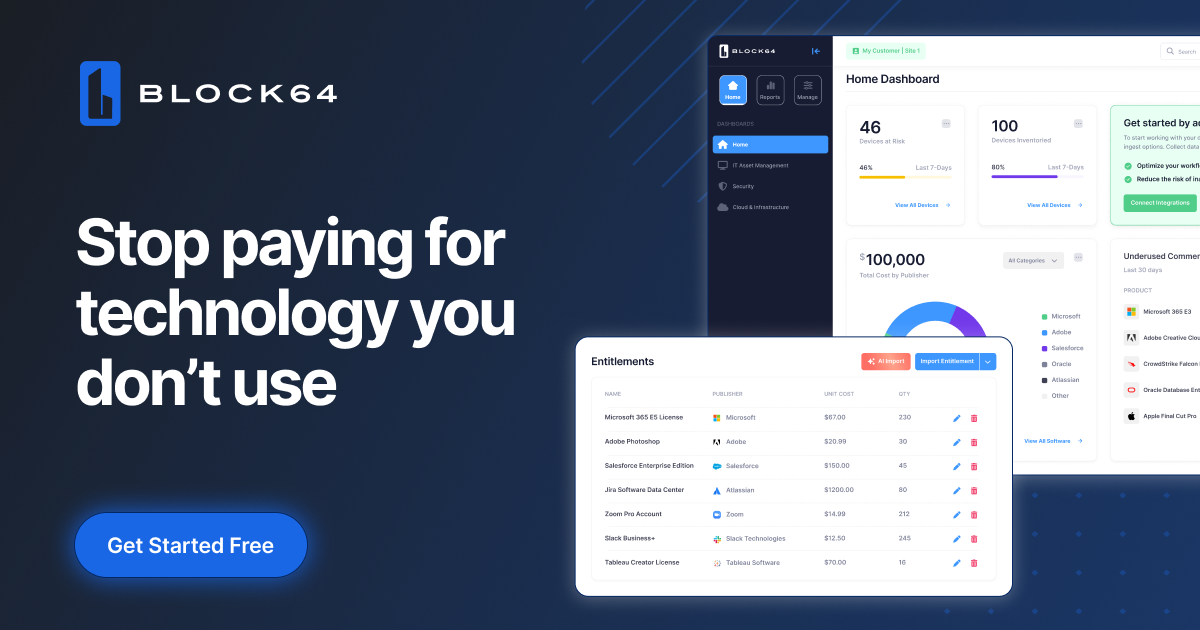
Block 64 takes a broader approach than SaaS-only tools, offering visibility across four layers of an organization’s technology environment:
- Critical SaaS apps
- Licensed/on-prem software
- Cloud workloads
- Hardware endpoints
Block 64 integrates with major systems and identity providers—including Microsoft 365, Google Workspace, Slack, Zoom, BambooHR, Atlassian, Entra ID, Okta, and Google Workspace—to deliver consistent, cross-environment insights.
With Block 64, organizations can:
- Discover critical SaaS apps, licensed software, cloud assets, and hardware endpoints
- Optimize licenses across SaaS and traditional vendors
- Improve security and audit readiness by surfacing shadow IT and configuration risks
- Unify reporting across IT, finance, and leadership
Rather than functioning as a traditional SMP, Block 64 acts as a unified IT visibility platform, giving organizations a connected view of their hybrid environments and reducing the need for siloed tools.
SaaS Spend and License Optimization
%20(1).png)
Organizations often waste significant spend on duplicate subscriptions, unused licenses, and redundant tools. SaaS spend management platforms help with part of that picture—but they rarely address cost leakage in traditional software, cloud services, or hardware renewals.
Platforms like Zylo and Zluri offer useful SaaS spend dashboards, but their scope stops at SaaS.
Block 64 closes this gap by combining SaaS spend visibility with traditional software asset management capabilities. This creates a consistent view of cost across:
- SaaS subscriptions
- Licensed desktop/server software
- Cloud workloads
- Hardware lifecycle data
Block 64’s direct connectors—including Microsoft 365, Google Workspace, Slack, BambooHR, Zoom, Atlassian, plus SSO/OAuth providers like Entra ID, Okta, and Google Workspace—strengthen entitlement and usage insights across the environment.
If you want this done for you, Block 64 also offers a fixed-scope SaaS and license rationalization assessment that maps your spend and flags reclaimable licenses in a defined engagement.
.png)
Security and Audit Readiness
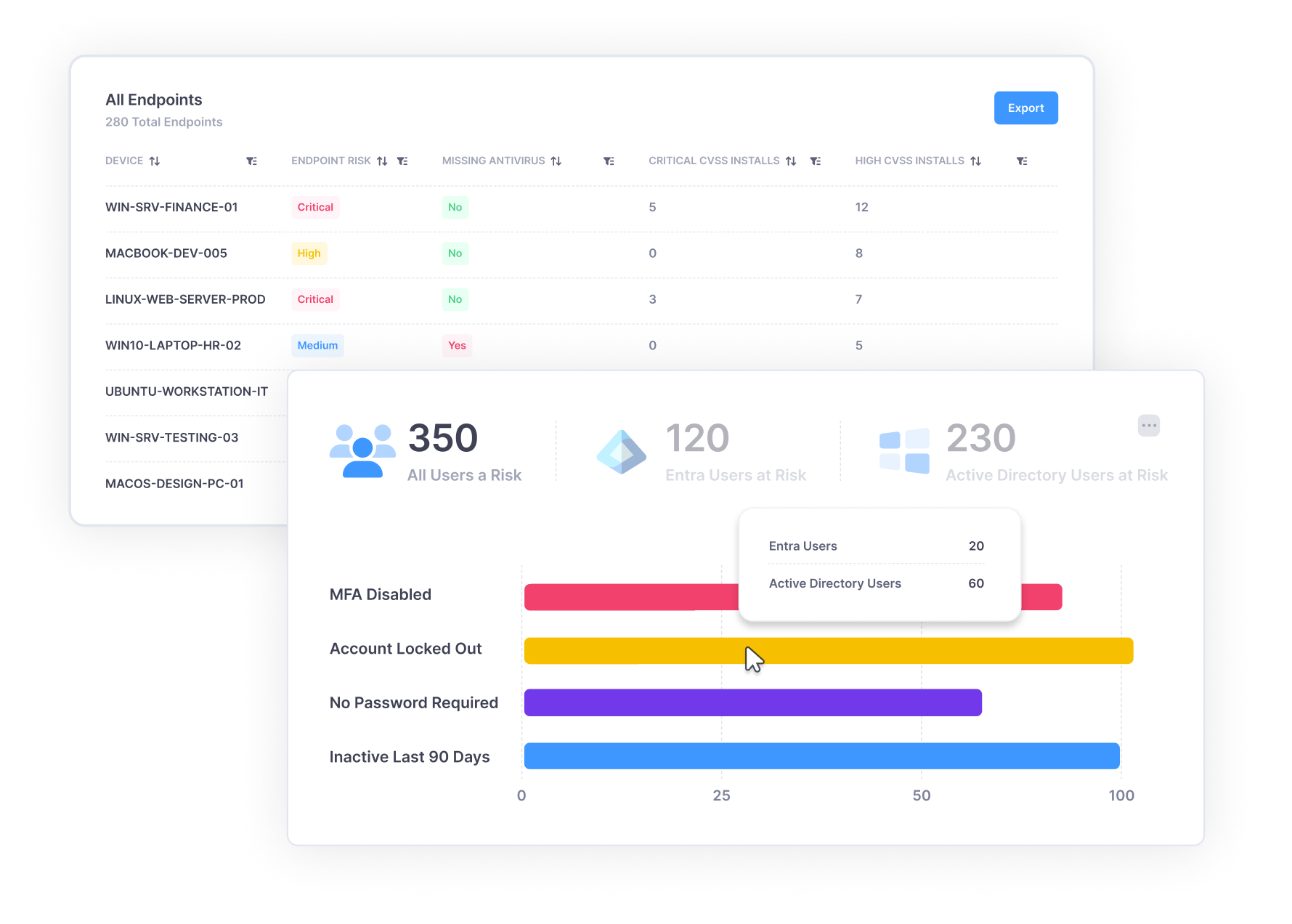
SaaS security posture management tools (SSPMs) help IT teams track configuration and access risks in SaaS environments. However, most SSPM-style features remain limited to a small number of integrations.
Block 64 expands risk and compliance visibility by detecting issues across SaaS, licensed software, cloud workloads, and endpoint assets. It supports audit preparation by consolidating entitlement, usage, and configuration data into exportable reports.
This continuous visibility helps organizations reduce shadow IT, identify misconfigurations earlier, and maintain audit-ready posture without relying on manual spreadsheets.
SaaS Management vs. Software Asset Management (SAM)
Historically, organizations managed SaaS and traditional software separately through SMPs and SAM tools. As hybrid IT environments became the norm, this separation created fragmented data and redundant processes.
This is why search interest in terms like SaaS IT management software and SaaS asset management keeps growing: teams want one system that tracks SaaS subscriptions and software licenses together, not two separate tools that never connect.
Organizations are now moving toward platforms that unify visibility across SaaS, software, cloud resources, and hardware.
Block 64 reflects this industry shift by offering visibility that spans all layers instead of focusing solely on SaaS or licensed software. This helps teams align cost optimization, risk reduction, and lifecycle management under one view.
Choosing a Platform for 2026 and Beyond
Tools like BetterCloud, Zylo, Zluri, Trelica, and CloudFuze each solve specific SaaS-focused problems. But for organizations operating in hybrid environments, SaaS-only visibility no longer provides the full picture.
Teams that want a faster path can start with a Block 64 Rapid Assessment, a fixed-price, defined-scope engagement that delivers the analysis and includes a 12-month platform subscription.
Block 64 gives IT, finance, and security teams a connected view across SaaS applications, licensed software, cloud workloads, and hardware assets—helping organizations reduce blind spots and make better decisions at scale.
As environments continue to diversify, platforms that unify multiple visibility layers will provide stronger long-term value than tools built solely around SaaS.
Frequently Asked Questions
What is a SaaS management tool?
A SaaS management tool, also called a SaaS management platform, discovers the SaaS applications in use across an organization, tracks their cost and renewals, and surfaces who has access. It pulls data from SSO, finance systems, and usage logs to give IT and finance a single view of the SaaS stack.
What is the best SaaS management platform in 2026?
There is no single best platform for every team. BetterCloud leads on SaaS automation, Zylo on spend analytics, and Zluri on access governance. For organizations that need visibility beyond SaaS into on-premise software, cloud, and hardware, Block 64 covers the full IT estate in one place rather than SaaS alone.
How is SaaS management different from software asset management (SAM)?
SaaS management focuses on cloud subscriptions: discovery, spend, and access. Software asset management covers licensed and on-premise software, entitlements, and compliance. As IT environments became hybrid, the two began to merge, and teams increasingly want one platform that handles both instead of separate tools.
Do SaaS management tools cover on-premise and cloud software?
Most do not. Traditional SaaS management platforms see only SaaS, which leaves gaps in licensed software, cloud workloads, and hardware. Unified visibility platforms like Block 64 close that gap by covering all four layers in a single view.
Final Word
The best SaaS management tools of 2026 offer strong value for SaaS-focused use cases. But as organizations operate increasingly hybrid environments, the need shifts from SaaS-only oversight to unified technology visibility.
Block 64 supports that shift by giving teams a single, consistent view across SaaS, software, cloud, and hardware—helping organizations improve cost governance, strengthen security, and stay audit-ready.
Prefer a done-for-you option? Start with a fixed-scope Rapid Assessment.