
For years, IT teams relied on the Microsoft Assessment and Planning Toolkit (MAP Toolkit) to inventory servers, assess hardware readiness, and prepare for Microsoft migrations. But with MAP effectively retired and no longer maintained, organizations that once depended on it are now navigating an IT landscape that has evolved far beyond the tool’s original purpose.
Cloud adoption, SaaS sprawl, hybrid estates, increased security pressures, and executive demand for real-time reporting have changed what an “assessment” truly needs to deliver. A manual or aging assessment tool doesn’t provide the visibility required to manage modern environments, reduce risk, or plan migrations with confidence.
This guide explains what MAP Toolkit was, why it no longer meets today’s needs, and what enterprises and mid-market organizations are adopting instead.
Need a MAP Toolkit alternative?
Block 64 scans your entire IT estate in minutes — not just Windows servers, but SaaS platforms, cloud workloads, endpoints, and dependencies.
You get a complete modernization and risk snapshot:
- Every server
- Every SaaS app
- Every cloud workload
- Every licensing exposure
- Executive-ready reporting
Deployment takes about 15 minutes. No sales call required.
What Was the MAP Toolkit? (Microsoft Assessment and Planning Toolkit)
The Microsoft Assessment and Planning Toolkit (MAP Toolkit) was a free, agentless discovery tool that helped organizations inventory servers, evaluate readiness for Microsoft deployments, and collect hardware/software data to support licensing and upgrade planning.
Core capabilities included:
- Agentless discovery of devices
- Hardware readiness checks for Windows, SQL Server, and other Microsoft products
- Basic performance metrics
- Hyper-V virtualization planning
- Licensing support for Microsoft products
Who used it:
Mid-sized to large organizations planning Windows Server upgrades, SQL migrations, virtualization projects, or environment clean-up prior to purchasing new Microsoft licenses.
The issue:
Microsoft stopped maintaining MAP Toolkit several years ago. There are no updates, no enhancements, no cloud support, and no coverage for modern toolchains. It functions, but only in the context of a world that no longer exists.
Is MAP Toolkit Still Supported? What Microsoft’s Retirement Means Today
MAP Toolkit is no longer updated or supported by Microsoft. Practically, that means:
- No updates for modern Windows Server versions
- No support for hybrid or multi-cloud environments
- Limited visibility into SaaS, shadow IT, or cloud spend
- No security or vulnerability insights
- No executive-ready reporting
- Increasing incompatibility with modern enterprise estates
For organizations relying on MAP Toolkit in 2025 and beyond, this creates operational blind spots and makes migration planning significantly riskier. IT leaders need assessments that reflect today’s realities — not a data set optimized for 2014.
The Assessment Challenges Modern Organizations Face
IT leaders today are being asked to:
- Reduce unnecessary cost across licensing and cloud
- Identify unused or shadow SaaS deployments
- Provide accurate inventory across hybrid estates
- Consolidate tools and eliminate redundancy
- Strengthen security posture
- Prepare for audits and compliance reviews
- Support migrations with real-time, evidence-based data
MAP Toolkit wasn’t designed for any of these — especially not the realities of SaaS sprawl, growing shadow IT, or the escalating cost pressures highlighted across recent industry research.
Modern assessments must deliver full IT estate visibility, not just Microsoft workloads — a requirement now driving organizations toward unified ITAM visibility platforms built for hybrid environments.
What Organizations Need Instead of MAP Toolkit
A modern MAP alternative must:
1. Deliver complete real-time visibility
Across servers, endpoints, SaaS platforms, cloud workloads, and shadow IT.
2. Operate agentlessly and scale instantly
Without complex setup, collection scripts, or manual uploads.
3. Provide security, compliance, and cost insights
MAP never addressed risks, vulnerabilities, spend exposure, or compliance.
4. Produce reporting for both technical and executive audiences
MAP reports were highly technical and often required manual translation.
5. Integrate into a unified assessment and planning process
Not a standalone snapshot requiring hours of manual consolidation.
This is why partners, MSPs, and enterprise IT teams have shifted to modern visibility platforms built for current environments.
MAP Toolkit vs Block 64: What Changes With a Modern Assessment
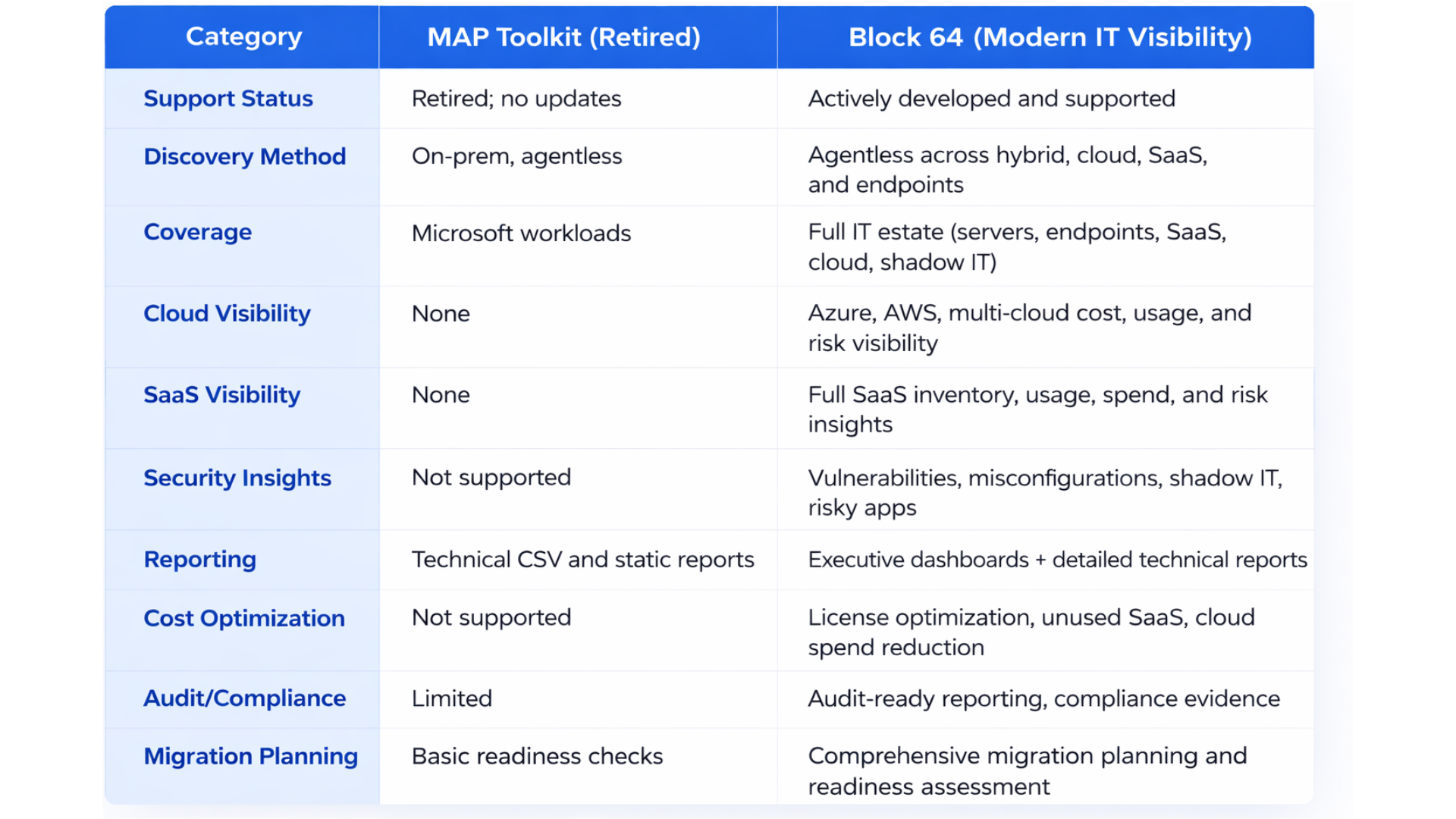
Below is a clear view of the differences between MAP Toolkit and a contemporary IT visibility platform such as Block 64. The difference is not incremental. It reflects a fundamental shift in how modern environments must be assessed.
Comparison: MAP Toolkit vs Block 64
Why Organizations Are Retiring MAP Toolkit and Adopting Block 64
Organizations are replacing MAP Toolkit for three key reasons:
1. The IT landscape evolved; MAP did not
MAP’s architecture reflects a pre-cloud era. Block 64 provides visibility across SaaS, shadow IT, endpoints, and multi-cloud workloads.
2. Leadership requires reporting MAP was never designed to deliver
Security posture, spend optimization, and compliance evidence have become mandatory.
3. Assessments today must be continuous, not one-off
MAP was a one-time snapshot. Block 64 offers ongoing visibility that supports quarterly reviews, budget cycles, cloud governance, and lifecycle planning.
When Teams Typically Replace MAP Toolkit
Most organizations move to a MAP alternative when they:
- Begin a Windows Server or SQL modernization project
- Need to rationalize SaaS spend
- Prepare for a cloud migration (Azure, AWS, multi-cloud)
- Consolidate redundant tools
- Strengthen security posture
- Support licensing or audit readiness
- Need a unified view of their entire IT estate
A Better Assessment Approach for Modern Environments
Block 64 provides real-time, evidence-based IT visibility that enables teams to:
- Discover every asset across hybrid estates
- Identify unused or risky SaaS applications
- Find cost savings in cloud and licensing
- Map dependencies and support migration planning
- Provide audit-ready compliance documentation
- Create both technical and executive-ready reports
- Reduce the risk of shadow IT and security gaps
This is the type of assessment data organizations need today — not a legacy toolset that no longer aligns with modern estate complexity.
Modern IT Requires Modern Visibility
MAP Toolkit played an important role in an earlier era of Microsoft migrations, but today’s IT environments require deeper, broader, and continuously updated insights. With Microsoft no longer maintaining MAP, organizations must shift toward solutions that address modern challenges: hybrid cloud, SaaS sprawl, security exposure, and cost optimization.
Block 64 offers organizations the visibility, accuracy, and reporting MAP Toolkit was never built to deliver — ensuring IT leaders can plan migrations, manage costs, and improve security with confidence.
Replace Legacy MAP Processes with Real-Time Visibility
If you're searching for a MAP Toolkit alternative, you likely need clarity — not another static inventory report.
Block 64 delivers:
- Real-time hybrid IT discovery
- Full SaaS and shadow IT visibility
- Cloud usage and cost intelligence
- License optimization insights
- Audit-ready reporting for leadership
Modern IT assessments must be continuous, not one-time snapshots.
Start with a free, agentless assessment and see your true exposure — across servers, SaaS, cloud, and endpoints.
Deployment takes minutes. No sales process required.