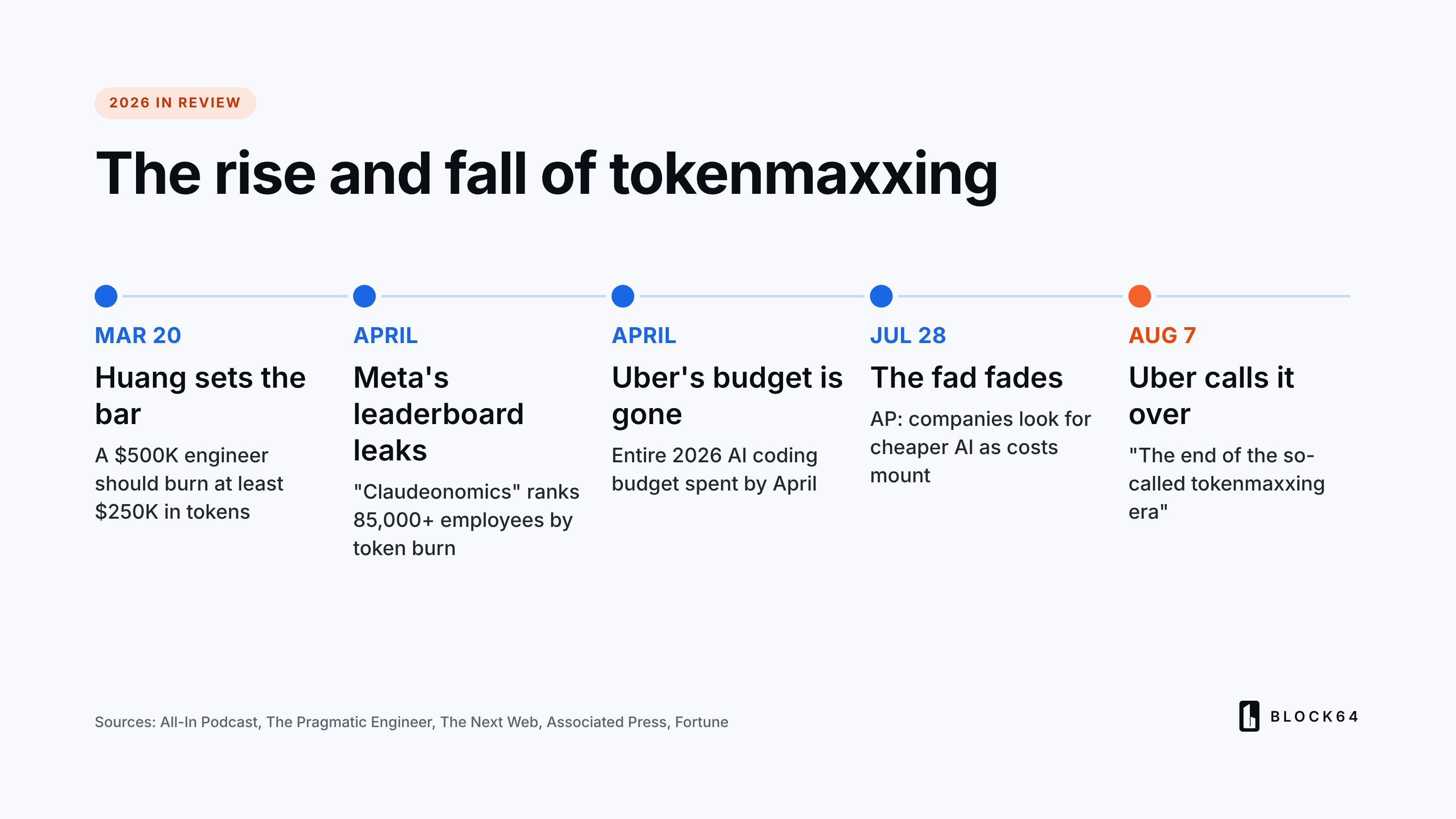
Earlier this year, more than 85,000 Meta employees could check where they ranked on an internal leaderboard called "Claudeonomics." The top spots came with titles like "Token Legend" and "Session Immortal," earned by burning more AI tokens than anyone else.
Nvidia CEO Jensen Huang said he'd be "deeply alarmed" if a $500,000 engineer didn't consume at least $250,000 worth of tokens.
Uber burned through its entire 2026 AI coding budget by April.
The trend had a name: tokenmaxxing. By August, Uber said the trend was dead.
"We're coming to the end of the so-called tokenmaxxing era," said Praveen Neppalli Naga, Uber's chief technology officer, as reported by Fortune.
Tokenmaxxing didn't fail because measuring AI is a bad idea. It failed because companies measured the wrong thing. And as mid-market IT teams head into 2027 budgets, the leaderboard is the least of their worries. The bigger problem is AI sprawl: tools, features, agents and spend spreading across the business faster than anyone can see them.
We talked through both with Brian Elliott, a 30-year tech executive who led the developer platform at Slack and now advises leaders on how AI is changing work, and Block 64 CEO James Corless. They came at it from opposite sides and landed in the same place. You can't measure what you can't see.
What is tokenmaxxing?
Tokenmaxxing is the practice of pushing employees, usually software developers, to consume as many AI tokens as possible, and treating that consumption as proof of productivity or AI fluency.
A token is the basic billing unit of generative AI, a small chunk of text a model reads or writes. Vendors bill by the token, which made it an easy number to track.
"Tokenmaxxing is the act of saying to somebody like a software developer, I want to actually see you use as many tokens as humanly possible," said Elliott.
At Meta, Microsoft and Salesforce, that turned into leaderboards and spending minimums, according to The Pragmatic Engineer. Meta's leaderboard tracked 60.2 trillion tokens in 30 days. Salesforce set minimum spending targets for AI coding tools, and employees burned tokens on projects that never shipped.
Why tokenmaxxing failed
Usage became the goal. And once a measure becomes a target, it stops being a good measure. Economists call that Goodhart's Law.
Elliott has a blunter version.
"Play stupid games, win stupid prizes. When you start incentivizing people off of maximizing tokens, they'll find a way to do it," he said.
One engineering director he spoke with figured the easiest way to top his company's leaderboard was to have AI rebuild one of his old 1990s Nintendo games every single day.
"So you can win, but are you actually adding any value?" Elliott said.
The bills, meanwhile, were very real. A Bain & Company consultant told the Associated Press that token costs can run about $200 a month per developer, which adds up fast across a large engineering team. The value was harder to find. In Atlassian's State of Teams 2026 research, 89% of executives said AI has made work faster, but only 6% could show clear ROI.
It's also worth asking who was cheering the loudest. Elliott shared a friend's reaction to Huang's tokens-for-half-your-salary comment.
"That's the guy who owns the pencil factory telling you to use more pencils. He's got all the commercial incentive in the world to get people to consume more tokens," Elliott said. "So take it with a massive grain of salt."
The AI adoption numbers don't match the hype
For mid-market IT leaders who feel behind, the data is reassuring.
US Census Bureau survey data from December 2025 to May 2026 shows overall business AI use hovering between 17% and 20%. Among firms with 100 to 249 employees, 32% reported using AI. Among firms with 250 or more, it was 37%.
Corless sees the same gap inside the environments Block 64 works in every day.
"The adoption of AI in core business operations, particularly in mid-market and mid-size customers, really is not as mature as the large AI vendors would have you believe," he said.
That's good news. Most organizations still have time to set up the right measurement before AI use hardens into AI sprawl.
From tokenmaxxing to AI sprawl: shadow AI doesn't wait for a policy
The leaderboards are gone. The usage isn't.
AI sprawl is the uncontrolled spread of AI tools, features, agents and spend across an organization, faster than IT can track who's using what, what data it touches and what it costs. Shadow AI is one part of it: AI tools employees use without IT's approval, the newest version of shadow IT.
Banning it doesn't work. In BCG's AI at Work 2025 survey of more than 10,600 workers, more than half said that if their company didn't provide the AI tools they needed, they'd find alternatives and use them anyway.
"You can't say no to employees. Thou shalt not use AI is just something that doesn't fly these days," Elliott said.
In the companies he advises, he sees three pressure points:
- Unsanctioned use. Employees will use AI regardless, so they need secure, approved tools that keep company data inside your control.
- Tool proliferation. Too many overlapping tools means teams experiment in different places with different results, and confusion follows.
- Builds that outlive their builders. Employees are creating agents and automations that can persist after they leave, with no clear owner.
That last one isn't hypothetical. When Elliott ran the Slack developer platform, one customer had more than 20,000 custom-built apps inside a single organization.
"You need governance that sits on top of this to help measure and monitor and understand who's going to own and maintain what you're building with these new AI tools and technologies," he said.
CIOs know the gap is there. In the Logicalis 2026 CIO Report, 62% of the 1,000 CIOs surveyed said they had compromised on AI governance because of limited knowledge.
IT has seen this movie: what cloud and SaaS sprawl teach us about AI sprawl
Corless has spent 25 years in IT, the first half implementing emerging technology and the second half helping customers manage it. AI looks familiar to him, with one important difference.
Cloud took time. Infrastructure, tenants, data pipelines and security layers all needed budget and executive sponsorship, which made early adoption more deliberate.
AI looks a lot more like SaaS sprawl.
"The decision to use a SaaS application is often made at the desktop and at the user level," Corless said. "As long as desktop users have access to corporate credit cards or a willingness to pull their personal credit card and expense it later, then there will be the sprawl that we've seen in SaaS."
He remembers an older version of the same pattern from his engineering days, when developers kept private desktop towers under their desks that nobody else knew about.
"Over time those rogue engineers were actually running production workloads under their desks," he said. "The data that it was processing was customer data and it wasn't always backed up or secured or monitored. And this all sounds very familiar."
Governance caught up then. He expects it will again.
"But we are nowhere near there today," Corless said.
What to measure instead of AI token usage
The fix for tokenmaxxing isn't measuring nothing. It's measuring in the right order.
Corless admits he felt the pull himself when generative AI took off and every leader worried their teams were falling behind.
"I can see how implementing some easy tokenomics-based measurement plans or leaderboards may have scratched the itch to take action," he said. "But I think the industry really needs to think about what's important. And I think what's important is business outcomes."
Elliott's advice is to stop letting a thousand flowers bloom and focus on the few areas where AI can move a real number. He borrows a line from a Harvard Business School professor.
"You can't feed a squirrel enough to turn it into an elephant," Elliott said.
Put together, the shift looks like this:
Every row on the right depends on the same thing: knowing what's actually running in your environment. That's the first principle of IT asset management, applied to a new kind of asset.
"Knowing what you have, knowing how you're using it is step one on your IT asset management journey," Corless said. "From that point, you're in a much better position to be focused on business outcomes and on true transformational AI adoption."
Tokenmaxxing and AI sprawl: FAQ
What is tokenmaxxing?
Tokenmaxxing is the practice of pushing employees to use as many AI tokens as possible and treating that usage as a measure of productivity. It peaked in early 2026 with internal token leaderboards at companies like Meta and Microsoft.
Is tokenmaxxing over?
Largely, yes. Meta took its leaderboard down after it became public, and in August 2026 Uber's CTO said the company was "coming to the end of the so-called tokenmaxxing era." Companies are now routing simple tasks to cheaper models and asking harder questions about ROI.
What is AI sprawl?
AI sprawl is the uncontrolled spread of AI tools, AI features inside existing software, agents and AI spend across an organization, without a full inventory, clear owners or a link to business outcomes.
What's the difference between AI sprawl and shadow AI?
Shadow AI is AI that employees use without IT's approval. AI sprawl is broader. It includes approved tools that overlap, AI switched on inside software you already own, and agents nobody owns once their builder leaves.
What should IT track instead of token usage?
Start with an inventory of what's in use, what it costs and what data it touches. Then measure business outcomes in a small number of priority areas, by team rather than by individual.
See what's really in your environment before 2027 budgets lock
Block 64 gives mid-market IT teams a clear, data-backed picture of the software, SaaS and licensing running across their environment, so AI decisions start from facts instead of leaderboards.
Our Rapid Assessments do the digging for you and deliver a defensible plan in 30 days, with a 12-month Block 64 platform subscription included.